
 Image 1 of 4
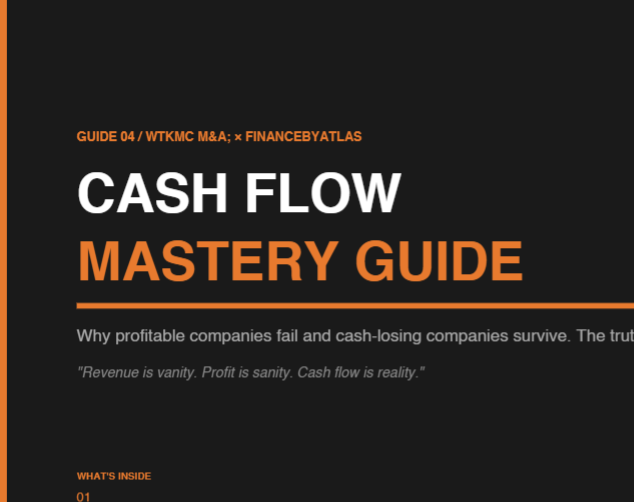 Image 2 of 4
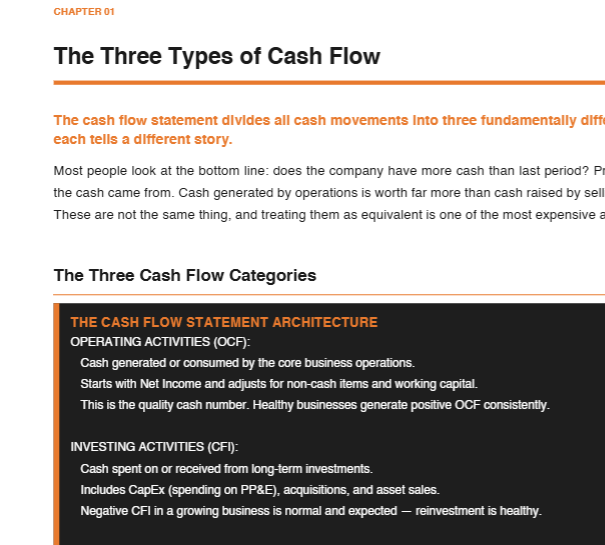 Image 3 of 4
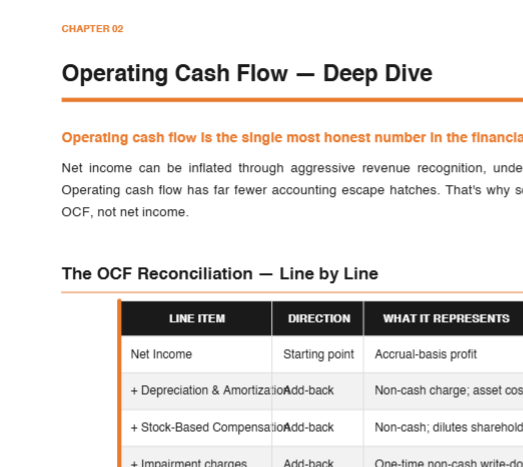 Image 4 of 4
Every year, profitable companies go bankrupt. Every year, loss-making companies raise hundreds of millions and keep operating. The reason is cash flow — and most people, including most business owners, do not understand it with the precision the subject demands.
This guide fixes that. It is the most complete explanation of cash flow at both personal and business levels — how it is calculated, how it is managed, how it is forecasted, and how it is used to make decisions.
WHAT'S INSIDE — 8 CHAPTERS:
→ The Three Types of Cash Flow
Operating, investing, and financing cash flows are not interchangeable. Cash generated by operations is worth fundamentally more than cash raised by selling assets or issuing debt — even if both increase your bank balance by the same amount. This chapter covers the cash flow statement architecture, the six cash flow pattern combinations and what each signals about the business, and the single most important insight: a company can be profitable and cash-negative simultaneously, and both terms require full explanation.
→ Operating Cash Flow — Deep Dive
OCF is the single most honest number in the financial statements. This chapter explains every adjustment in the OCF reconciliation — depreciation, stock-based compensation, deferred taxes, changes in receivables, inventory, payables, accrued liabilities, and deferred revenue — with the economic meaning of each and the analytical questions each one raises.
→ Free Cash Flow — Calculation and Interpretation
Six FCF variants — simple, maintenance, FCFF, FCFE, levered, and Buffett's owner earnings — with when to use each and what each reveals. The full derivation of maintenance vs. growth CapEx using four estimation methods, including the depreciation proxy and revenue-based approaches.
→ Working Capital Dynamics
The cash conversion cycle explained with precision: DSO, DIO, DPO, and how their interaction determines whether growth consumes cash or generates it. A full reference table showing the CCC for seven company types, from Amazon's −20 to −30 days (self-financing) to construction businesses at +60 to +120 days (cash-hungry). Includes the five levers for improving CCC.
→ Burn Rate & Liquidity Management
Gross vs. net burn rate with definitions, formulas, and the correct interpretation of each. A complete liquidity risk assessment framework with thresholds across seven metrics — from cash runway to quick ratio to FCF/Debt coverage. The safe, warning, and crisis thresholds for each.
→ Cash Flow Forecasting
The 13-week rolling cash flow forecast — the standard instrument for operational liquidity management. The six-step process. The three-scenario model (bear, base, bull). A visual chart of what those three trajectories look like over seven months and why the bear case is the one that determines survival.
→ The Cash Conversion Cycle as Competitive Advantage
Negative working capital is one of the most underappreciated competitive advantages in business. Amazon, Costco, and McDonald's are partially built on it. This chapter explains how each CCC improvement lever works and what the operational and relationship tradeoffs look like.
→ Why Profitable Companies Run Out of Cash
Six specific mechanisms by which profitable, apparently healthy businesses fail due to cash constraints: rapid growth consuming working capital, CapEx-funded expansion with thin FCF, seasonal mismatch, debt maturity walls, deferred revenue crystallization, and off-balance-sheet obligations. Each explained with the specific cash dynamic that makes it lethal.
WHO THIS IS FOR:
Business owners, CFOs, analysts, and investors who want to understand cash flow at the level where decisions are actually made — not just the headline numbers.
FORMAT: PDF — Instant download. No subscription. Yours forever.
Every year, profitable companies go bankrupt. Every year, loss-making companies raise hundreds of millions and keep operating. The reason is cash flow — and most people, including most business owners, do not understand it with the precision the subject demands.
This guide fixes that. It is the most complete explanation of cash flow at both personal and business levels — how it is calculated, how it is managed, how it is forecasted, and how it is used to make decisions.
WHAT'S INSIDE — 8 CHAPTERS:
→ The Three Types of Cash Flow
Operating, investing, and financing cash flows are not interchangeable. Cash generated by operations is worth fundamentally more than cash raised by selling assets or issuing debt — even if both increase your bank balance by the same amount. This chapter covers the cash flow statement architecture, the six cash flow pattern combinations and what each signals about the business, and the single most important insight: a company can be profitable and cash-negative simultaneously, and both terms require full explanation.
→ Operating Cash Flow — Deep Dive
OCF is the single most honest number in the financial statements. This chapter explains every adjustment in the OCF reconciliation — depreciation, stock-based compensation, deferred taxes, changes in receivables, inventory, payables, accrued liabilities, and deferred revenue — with the economic meaning of each and the analytical questions each one raises.
→ Free Cash Flow — Calculation and Interpretation
Six FCF variants — simple, maintenance, FCFF, FCFE, levered, and Buffett's owner earnings — with when to use each and what each reveals. The full derivation of maintenance vs. growth CapEx using four estimation methods, including the depreciation proxy and revenue-based approaches.
→ Working Capital Dynamics
The cash conversion cycle explained with precision: DSO, DIO, DPO, and how their interaction determines whether growth consumes cash or generates it. A full reference table showing the CCC for seven company types, from Amazon's −20 to −30 days (self-financing) to construction businesses at +60 to +120 days (cash-hungry). Includes the five levers for improving CCC.
→ Burn Rate & Liquidity Management
Gross vs. net burn rate with definitions, formulas, and the correct interpretation of each. A complete liquidity risk assessment framework with thresholds across seven metrics — from cash runway to quick ratio to FCF/Debt coverage. The safe, warning, and crisis thresholds for each.
→ Cash Flow Forecasting
The 13-week rolling cash flow forecast — the standard instrument for operational liquidity management. The six-step process. The three-scenario model (bear, base, bull). A visual chart of what those three trajectories look like over seven months and why the bear case is the one that determines survival.
→ The Cash Conversion Cycle as Competitive Advantage
Negative working capital is one of the most underappreciated competitive advantages in business. Amazon, Costco, and McDonald's are partially built on it. This chapter explains how each CCC improvement lever works and what the operational and relationship tradeoffs look like.
→ Why Profitable Companies Run Out of Cash
Six specific mechanisms by which profitable, apparently healthy businesses fail due to cash constraints: rapid growth consuming working capital, CapEx-funded expansion with thin FCF, seasonal mismatch, debt maturity walls, deferred revenue crystallization, and off-balance-sheet obligations. Each explained with the specific cash dynamic that makes it lethal.
WHO THIS IS FOR:
Business owners, CFOs, analysts, and investors who want to understand cash flow at the level where decisions are actually made — not just the headline numbers.
FORMAT: PDF — Instant download. No subscription. Yours forever.