
 Image 1 of 4
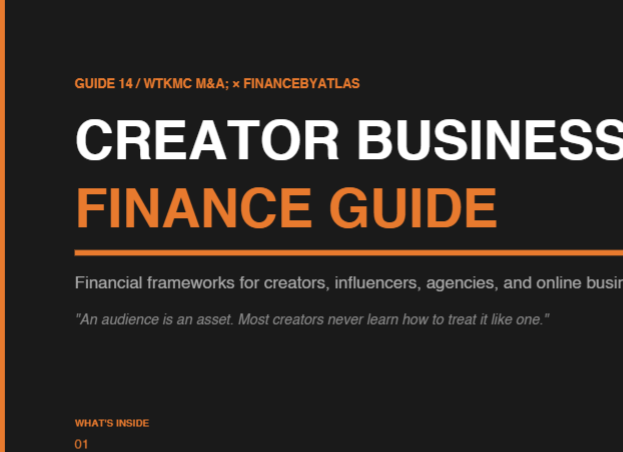 Image 2 of 4
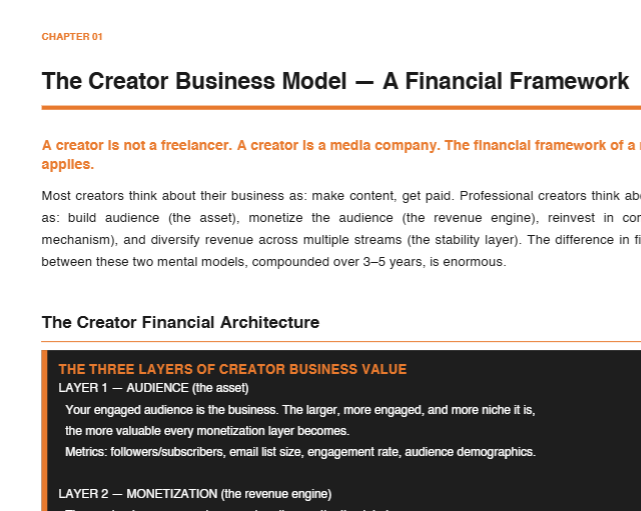 Image 3 of 4
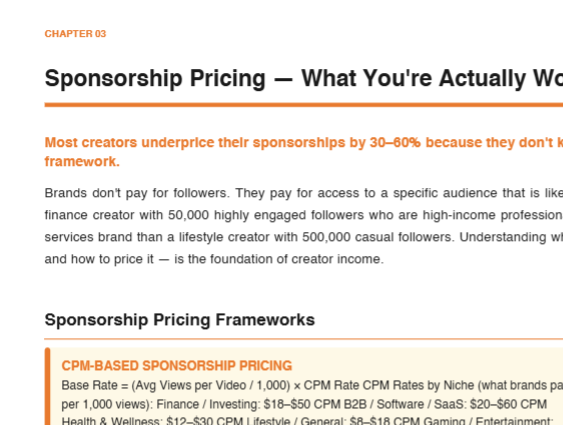 Image 4 of 4
A creator is not a freelancer. A creator is a media company. And media companies have financial frameworks, tax structures, revenue architectures, and business valuations that most creators never learn — because no one tells them.
This guide fills that gap. It is the financial operating manual for creators, influencers, agencies, and online businesses: revenue strategy, pricing, taxes, business structure, cash flow management, and scaling.
WHAT'S INSIDE — 8 CHAPTERS:
→ The Creator Business Model — A Financial Framework
The three-layer creator business architecture: audience (the asset), monetization (the revenue engine), and reinvestment (the growth mechanism). A comparison of eight creator business models — sponsorship-only through hybrid multi-stream — with gross margin, scale ceiling, and primary vulnerability for each. Why the hybrid model with three to five revenue streams balanced across types is the professional standard.
→ Revenue Stream Architecture — Building Multiple Income Layers
Platform dependency is the biggest financial vulnerability in the creator economy. A single algorithm change, policy shift, or advertiser pullback can eliminate income concentrated in one source in 30–60 days. This chapter covers ten revenue streams — from brand sponsorships and email newsletter ads through digital courses, memberships, consulting, and live events — with margin, predictability, audience requirement, and setup complexity for each.
→ Sponsorship Pricing — What You're Actually Worth
Most creators underprice their sponsorships by 30–60% because they don't know the CPM framework. Brands don't pay for followers — they pay for access to a specific, engaged audience likely to purchase their product. This chapter covers CPM rates by niche (finance: $18–50, B2B software: $20–60, lifestyle: $8–18), the full multiplier table (dedicated video, exclusivity, engagement rate, email inclusion, deal length), and how to build a rate card that is defensible and profitable.
→ Digital Product Economics
A digital product is built once and sold an infinite number of times at near-zero marginal cost. This is the most favorable margin structure in commerce: 85–97% gross margins depending on product type and platform. This chapter breaks down the margin analysis for eight digital product types, walks through the full revenue projection formula (email list × conversion rate × price), and shows what a 0.1% conversion rate improvement means at scale.
→ Taxes for Creators — The Most Costly Mistake
Self-employed creators pay self-employment tax (15.3%) on top of federal income tax — not instead of it. At 22% federal bracket, that's 37%+ before state taxes. This chapter covers the full creator tax stack, the complete deduction list (home office, equipment, software, travel, contractor payments, health insurance premiums, retirement contributions, and the QBI deduction), the quarterly estimated payment schedule, and a worked example of S-Corporation tax savings at $150,000 net income showing approximately $8,500 in annual savings.
→ Business Entities and Structure
Five entity types — sole proprietorship, single-member LLC, S-Corporation, C-Corporation, and partnership — with tax treatment, liability protection, best-fit scenario, and when to make the transition. The S-Corporation tax savings worked example showing exactly how the reasonable salary + distribution structure reduces self-employment tax on income above the salary threshold. The structural decision most creators making $60,000+ net profit delay by 2–3 years and should not.
→ Cash Flow Management for Variable Income
The most dangerous financial position for a creator is confusing a great month for a great business. This chapter covers the creator cash flow architecture — all revenue in, tax reserve out immediately (30–35%), business reserve, reinvestment, and fixed owner's pay from the remainder. The income smoothing approach: pay yourself a fixed monthly salary of 60–70% of the 12-month trailing average, regardless of what the business earned that month. Eliminates lifestyle volatility without constraining business investment.
→ Scaling the Creator Business — The Exit Options
A creator business built correctly has real enterprise value. Media companies, PE firms, and strategic buyers are acquiring creator businesses with recurring revenue, owned audiences, and diversified income. This chapter covers the six value drivers buyers look for (owned audience, recurring revenue, diversified income, systems and team, brand IP, high-income demographics) and the valuation multiples by business type — from sponsorship-dependent (1–3× revenue) through SaaS-like creator business with membership and products (4–10× recurring revenue).
WHO THIS IS FOR:
Creators, influencers, and content businesses at any stage who want to run their operation like a business — not a hobby with income. Anyone earning from online audiences who has never seen their financial model written down clearly.
FORMAT: PDF — Instant download. No subscription. Yours forever.
A creator is not a freelancer. A creator is a media company. And media companies have financial frameworks, tax structures, revenue architectures, and business valuations that most creators never learn — because no one tells them.
This guide fills that gap. It is the financial operating manual for creators, influencers, agencies, and online businesses: revenue strategy, pricing, taxes, business structure, cash flow management, and scaling.
WHAT'S INSIDE — 8 CHAPTERS:
→ The Creator Business Model — A Financial Framework
The three-layer creator business architecture: audience (the asset), monetization (the revenue engine), and reinvestment (the growth mechanism). A comparison of eight creator business models — sponsorship-only through hybrid multi-stream — with gross margin, scale ceiling, and primary vulnerability for each. Why the hybrid model with three to five revenue streams balanced across types is the professional standard.
→ Revenue Stream Architecture — Building Multiple Income Layers
Platform dependency is the biggest financial vulnerability in the creator economy. A single algorithm change, policy shift, or advertiser pullback can eliminate income concentrated in one source in 30–60 days. This chapter covers ten revenue streams — from brand sponsorships and email newsletter ads through digital courses, memberships, consulting, and live events — with margin, predictability, audience requirement, and setup complexity for each.
→ Sponsorship Pricing — What You're Actually Worth
Most creators underprice their sponsorships by 30–60% because they don't know the CPM framework. Brands don't pay for followers — they pay for access to a specific, engaged audience likely to purchase their product. This chapter covers CPM rates by niche (finance: $18–50, B2B software: $20–60, lifestyle: $8–18), the full multiplier table (dedicated video, exclusivity, engagement rate, email inclusion, deal length), and how to build a rate card that is defensible and profitable.
→ Digital Product Economics
A digital product is built once and sold an infinite number of times at near-zero marginal cost. This is the most favorable margin structure in commerce: 85–97% gross margins depending on product type and platform. This chapter breaks down the margin analysis for eight digital product types, walks through the full revenue projection formula (email list × conversion rate × price), and shows what a 0.1% conversion rate improvement means at scale.
→ Taxes for Creators — The Most Costly Mistake
Self-employed creators pay self-employment tax (15.3%) on top of federal income tax — not instead of it. At 22% federal bracket, that's 37%+ before state taxes. This chapter covers the full creator tax stack, the complete deduction list (home office, equipment, software, travel, contractor payments, health insurance premiums, retirement contributions, and the QBI deduction), the quarterly estimated payment schedule, and a worked example of S-Corporation tax savings at $150,000 net income showing approximately $8,500 in annual savings.
→ Business Entities and Structure
Five entity types — sole proprietorship, single-member LLC, S-Corporation, C-Corporation, and partnership — with tax treatment, liability protection, best-fit scenario, and when to make the transition. The S-Corporation tax savings worked example showing exactly how the reasonable salary + distribution structure reduces self-employment tax on income above the salary threshold. The structural decision most creators making $60,000+ net profit delay by 2–3 years and should not.
→ Cash Flow Management for Variable Income
The most dangerous financial position for a creator is confusing a great month for a great business. This chapter covers the creator cash flow architecture — all revenue in, tax reserve out immediately (30–35%), business reserve, reinvestment, and fixed owner's pay from the remainder. The income smoothing approach: pay yourself a fixed monthly salary of 60–70% of the 12-month trailing average, regardless of what the business earned that month. Eliminates lifestyle volatility without constraining business investment.
→ Scaling the Creator Business — The Exit Options
A creator business built correctly has real enterprise value. Media companies, PE firms, and strategic buyers are acquiring creator businesses with recurring revenue, owned audiences, and diversified income. This chapter covers the six value drivers buyers look for (owned audience, recurring revenue, diversified income, systems and team, brand IP, high-income demographics) and the valuation multiples by business type — from sponsorship-dependent (1–3× revenue) through SaaS-like creator business with membership and products (4–10× recurring revenue).
WHO THIS IS FOR:
Creators, influencers, and content businesses at any stage who want to run their operation like a business — not a hobby with income. Anyone earning from online audiences who has never seen their financial model written down clearly.
FORMAT: PDF — Instant download. No subscription. Yours forever.