
 Image 1 of 4
 Image 2 of 4
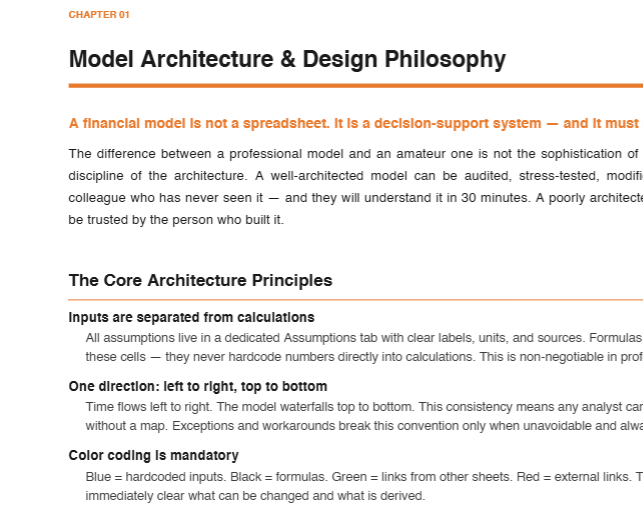 Image 3 of 4
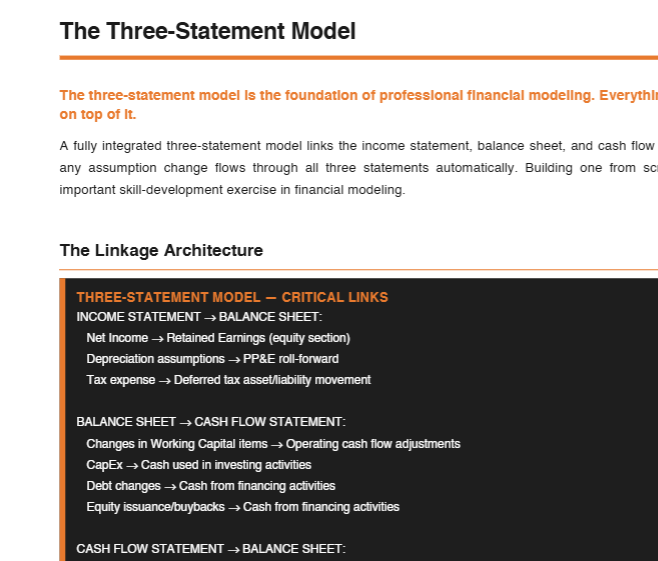 Image 4 of 4
The difference between a professional financial model and an amateur one is not formula sophistication. It is architectural discipline. A professionally built model can be handed to a colleague who has never seen it — and understood in 30 minutes. An amateur model cannot be trusted by the person who built it.
This handbook is designed to pair with the Excel templates in this store. It explains the structure, logic, and discipline behind every model we build — so you can use them correctly, modify them intelligently, and eventually build your own.
WHAT'S INSIDE — 8 CHAPTERS:
→ Model Architecture & Design Philosophy
The five non-negotiable principles: inputs separated from calculations, one directional flow (left to right, top to bottom), mandatory color coding (blue = hardcoded inputs, black = formulas, green = cross-sheet links), no unnecessary circularity, and self-auditing error checks. The complete 11-tab structure used in professional models with the purpose and color convention for each tab.
→ Forecasting Assumptions — Building the Engine
The assumption hierarchy — historical data, management guidance, street consensus, industry benchmarks, analyst view — and why the order matters. Six revenue assumption types with when each is appropriate and what it requires. The assumption documentation standard: source, date, rationale, and sensitivity for every non-trivial number. Undocumented assumptions are liabilities.
→ The Three-Statement Model
A fully integrated three-statement model links income statement, balance sheet, and cash flow statement so that any change flows through all three automatically. This chapter covers every critical linkage — net income to retained earnings, D&A to PP&E rollforward, working capital changes to cash flow adjustments — and the six most common locations of balance sheet errors.
→ Debt Schedules & Interest Calculations
Seven debt types — investment grade bonds, high yield, leveraged loans, revolvers, TLA, TLB, and convertible notes — with the correct modeling approach, key assumptions, and circular reference status for each. Two methods for handling the interest circularity: prior-period balance reference and iterative calculation with convergence control.
→ Scenario & Sensitivity Analysis
How to build a two-variable data table in Excel correctly — the exact steps, where the common errors occur, and how to verify the output. The scenario architecture that allows switching between complete assumption sets with a single toggle. A five-row scenario reference (bear through recession) showing revenue growth, EBITDA margin, CapEx, and terminal growth rate assumptions for each.
→ Valuation Integration
The valuation football field — the horizontal bar chart showing implied value ranges across multiple methods — as the professional standard for valuation output. A seven-row method selection framework: which valuation method is primary and secondary for each company type from profitable and stable through early-stage startup through financial institutions.
→ Model Hygiene & Error Prevention
The six principles that prevent the most common model errors: no hardcoded numbers in formulas, consistent formula patterns, cross-sheet reference verification, balance sheet check row, sensitivity output verification, and version control discipline. The JPMorgan London Whale and Reinhart-Rogoff cases as real-world examples of what model errors cost.
→ Advanced Modeling Techniques
Eight advanced techniques — sum-of-the-parts valuation, LBO modeling, merger consequences, credit modeling, options pricing in models, foreign currency translation, earnout modeling, and Monte Carlo simulation — with when each is needed and the key complexity each introduces.
WHO THIS IS FOR:
Finance professionals who want a clean reference for best practices. Students building their first models who want to avoid the habits that are hard to unlearn. Anyone using our Excel templates who wants to understand the logic behind what they're using.
FORMAT: PDF — Instant download. No subscription. Yours forever.
The difference between a professional financial model and an amateur one is not formula sophistication. It is architectural discipline. A professionally built model can be handed to a colleague who has never seen it — and understood in 30 minutes. An amateur model cannot be trusted by the person who built it.
This handbook is designed to pair with the Excel templates in this store. It explains the structure, logic, and discipline behind every model we build — so you can use them correctly, modify them intelligently, and eventually build your own.
WHAT'S INSIDE — 8 CHAPTERS:
→ Model Architecture & Design Philosophy
The five non-negotiable principles: inputs separated from calculations, one directional flow (left to right, top to bottom), mandatory color coding (blue = hardcoded inputs, black = formulas, green = cross-sheet links), no unnecessary circularity, and self-auditing error checks. The complete 11-tab structure used in professional models with the purpose and color convention for each tab.
→ Forecasting Assumptions — Building the Engine
The assumption hierarchy — historical data, management guidance, street consensus, industry benchmarks, analyst view — and why the order matters. Six revenue assumption types with when each is appropriate and what it requires. The assumption documentation standard: source, date, rationale, and sensitivity for every non-trivial number. Undocumented assumptions are liabilities.
→ The Three-Statement Model
A fully integrated three-statement model links income statement, balance sheet, and cash flow statement so that any change flows through all three automatically. This chapter covers every critical linkage — net income to retained earnings, D&A to PP&E rollforward, working capital changes to cash flow adjustments — and the six most common locations of balance sheet errors.
→ Debt Schedules & Interest Calculations
Seven debt types — investment grade bonds, high yield, leveraged loans, revolvers, TLA, TLB, and convertible notes — with the correct modeling approach, key assumptions, and circular reference status for each. Two methods for handling the interest circularity: prior-period balance reference and iterative calculation with convergence control.
→ Scenario & Sensitivity Analysis
How to build a two-variable data table in Excel correctly — the exact steps, where the common errors occur, and how to verify the output. The scenario architecture that allows switching between complete assumption sets with a single toggle. A five-row scenario reference (bear through recession) showing revenue growth, EBITDA margin, CapEx, and terminal growth rate assumptions for each.
→ Valuation Integration
The valuation football field — the horizontal bar chart showing implied value ranges across multiple methods — as the professional standard for valuation output. A seven-row method selection framework: which valuation method is primary and secondary for each company type from profitable and stable through early-stage startup through financial institutions.
→ Model Hygiene & Error Prevention
The six principles that prevent the most common model errors: no hardcoded numbers in formulas, consistent formula patterns, cross-sheet reference verification, balance sheet check row, sensitivity output verification, and version control discipline. The JPMorgan London Whale and Reinhart-Rogoff cases as real-world examples of what model errors cost.
→ Advanced Modeling Techniques
Eight advanced techniques — sum-of-the-parts valuation, LBO modeling, merger consequences, credit modeling, options pricing in models, foreign currency translation, earnout modeling, and Monte Carlo simulation — with when each is needed and the key complexity each introduces.
WHO THIS IS FOR:
Finance professionals who want a clean reference for best practices. Students building their first models who want to avoid the habits that are hard to unlearn. Anyone using our Excel templates who wants to understand the logic behind what they're using.
FORMAT: PDF — Instant download. No subscription. Yours forever.