
 Image 1 of 4
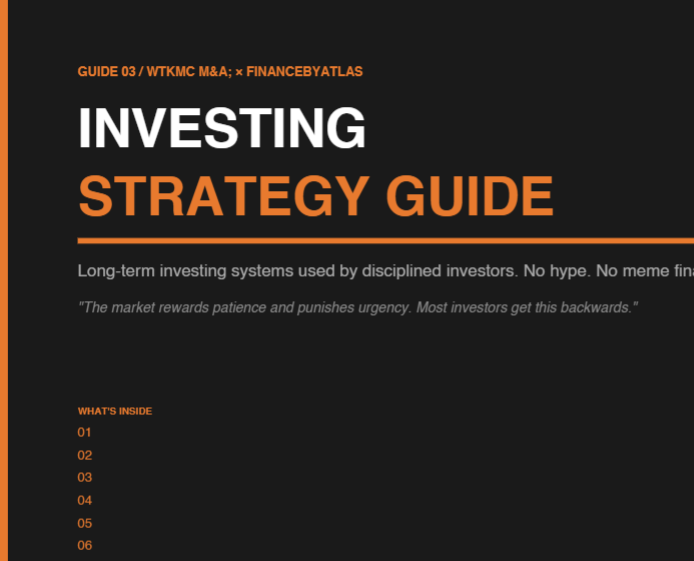 Image 2 of 4
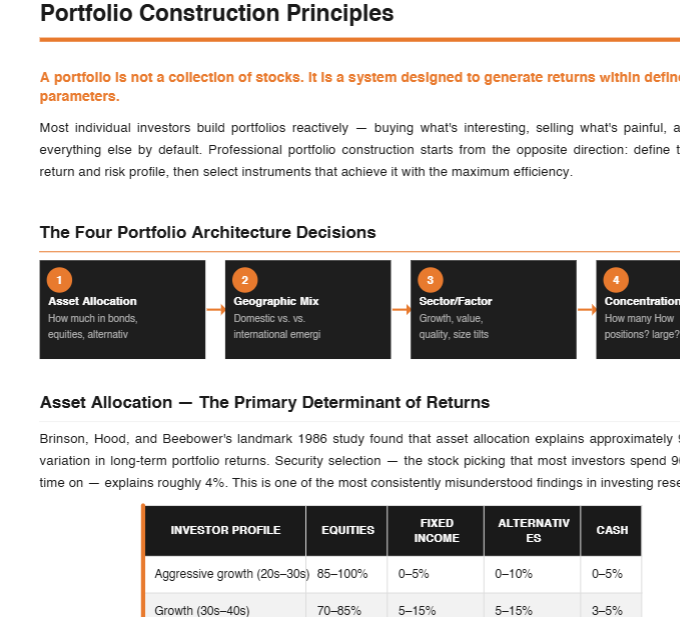 Image 3 of 4
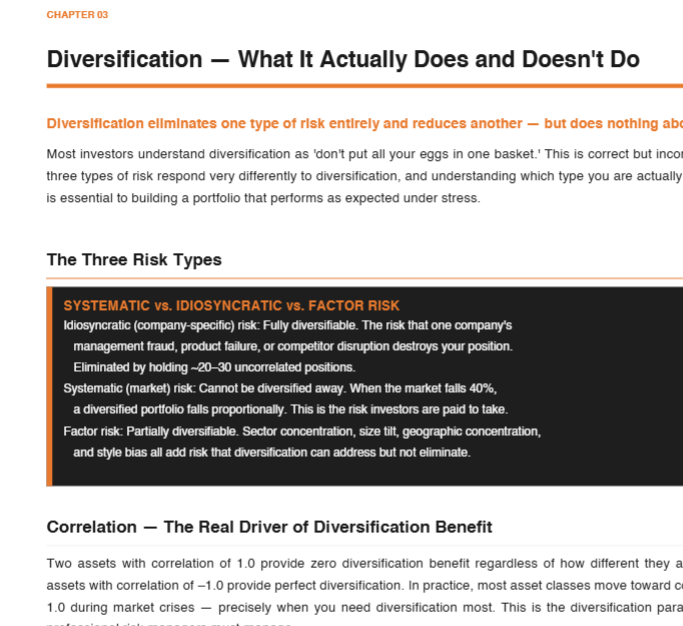 Image 4 of 4
This is not a guide about stock picks, hot sectors, or market timing. It is a complete investing framework for people who want to build wealth systematically over the long term — without hype, without meme finance, and without the illusion that complexity equals sophistication.
Every framework in here is used by disciplined, long-term investors who consistently outperform. None of it requires prediction. All of it requires process.
WHAT'S INSIDE — 8 CHAPTERS:
→ Portfolio Construction Principles
A portfolio is not a collection of interesting stocks. It is a system designed to generate a target return within a defined risk parameter. This chapter covers the four portfolio architecture decisions — asset allocation, geographic mix, sector/factor tilt, and concentration — and explains why Brinson, Hood, and Beebower's landmark research showed that asset allocation explains approximately 90% of long-run return variation. Stock selection explains roughly 4%.
→ Risk Allocation & Position Sizing
Position sizing is not about how confident you feel. It is about how much you can afford to lose. This chapter covers the Kelly Criterion and its fractional application, position sizing by position type (core conviction through speculative), and why the maximum single-name position for a retail portfolio has a defensible upper limit.
→ Diversification — What It Actually Does
Diversification eliminates idiosyncratic (company-specific) risk entirely. It reduces factor risk partially. It does nothing about systematic (market) risk. This chapter explains the three risk types, the correlation dynamics that determine actual diversification benefit, and the reason most portfolios provide less protection than their owners believe — especially during market crises when correlations converge toward 1.0.
→ Market Psychology & Behavioral Finance
The biggest risk in investing is not the market. It is the investor. This chapter covers eight core behavioral biases — loss aversion, recency bias, overconfidence, herding, anchoring, narrative fallacy, availability heuristic, and reflexivity — with their specific market manifestations and the mispricings they create.
→ Compound Growth — The Mechanics
A complete compound growth table: $10,000 invested at 4% through 20% return across 10, 20, 30, and 40 year horizons. The difference between 8% and 12% over 40 years is not 50% more wealth — it is over 4× more. This chapter explains the three laws of compounding and why fees, taxes, and large losses compound negatively at the same rate as returns compound positively.
→ Investing Styles — The Complete Taxonomy
Eight major investing styles — Value, Quality/Compounder, Growth, GARP, Dividend/Income, Index/Passive, Macro, Activist — with core logic, key metrics, temperament fit, and time horizon for each. Most investors fail not because they chose the wrong style, but because they tried to use two incompatible styles simultaneously.
→ Volatility Management
Volatility is not risk. A stock that swings 30% per year but compounds at 15% per decade has high volatility and excellent returns. A stock that barely moves for five years and then falls 80% permanently has low volatility and catastrophic risk. This chapter covers six volatility metrics — standard deviation, beta, Sharpe, Sortino, maximum drawdown, VaR, and CVaR — with what each actually measures and where each fails.
→ Building a Sustainable Investment Process
The investors who outperform over decades are not necessarily smarter. They have more robust processes. This chapter outlines the professional investment process from idea generation through thesis documentation, sizing, and quarterly monitoring — and makes the case for the investment journal as the non-negotiable foundation of any serious investing practice.
WHO THIS IS FOR:
Investors at any level who want to replace guessing with a system. Anyone who has ever panic-sold, over-concentrated, or chased performance and wants a framework that prevents it.
FORMAT: PDF — Instant download. No subscription. Yours forever.
This is not a guide about stock picks, hot sectors, or market timing. It is a complete investing framework for people who want to build wealth systematically over the long term — without hype, without meme finance, and without the illusion that complexity equals sophistication.
Every framework in here is used by disciplined, long-term investors who consistently outperform. None of it requires prediction. All of it requires process.
WHAT'S INSIDE — 8 CHAPTERS:
→ Portfolio Construction Principles
A portfolio is not a collection of interesting stocks. It is a system designed to generate a target return within a defined risk parameter. This chapter covers the four portfolio architecture decisions — asset allocation, geographic mix, sector/factor tilt, and concentration — and explains why Brinson, Hood, and Beebower's landmark research showed that asset allocation explains approximately 90% of long-run return variation. Stock selection explains roughly 4%.
→ Risk Allocation & Position Sizing
Position sizing is not about how confident you feel. It is about how much you can afford to lose. This chapter covers the Kelly Criterion and its fractional application, position sizing by position type (core conviction through speculative), and why the maximum single-name position for a retail portfolio has a defensible upper limit.
→ Diversification — What It Actually Does
Diversification eliminates idiosyncratic (company-specific) risk entirely. It reduces factor risk partially. It does nothing about systematic (market) risk. This chapter explains the three risk types, the correlation dynamics that determine actual diversification benefit, and the reason most portfolios provide less protection than their owners believe — especially during market crises when correlations converge toward 1.0.
→ Market Psychology & Behavioral Finance
The biggest risk in investing is not the market. It is the investor. This chapter covers eight core behavioral biases — loss aversion, recency bias, overconfidence, herding, anchoring, narrative fallacy, availability heuristic, and reflexivity — with their specific market manifestations and the mispricings they create.
→ Compound Growth — The Mechanics
A complete compound growth table: $10,000 invested at 4% through 20% return across 10, 20, 30, and 40 year horizons. The difference between 8% and 12% over 40 years is not 50% more wealth — it is over 4× more. This chapter explains the three laws of compounding and why fees, taxes, and large losses compound negatively at the same rate as returns compound positively.
→ Investing Styles — The Complete Taxonomy
Eight major investing styles — Value, Quality/Compounder, Growth, GARP, Dividend/Income, Index/Passive, Macro, Activist — with core logic, key metrics, temperament fit, and time horizon for each. Most investors fail not because they chose the wrong style, but because they tried to use two incompatible styles simultaneously.
→ Volatility Management
Volatility is not risk. A stock that swings 30% per year but compounds at 15% per decade has high volatility and excellent returns. A stock that barely moves for five years and then falls 80% permanently has low volatility and catastrophic risk. This chapter covers six volatility metrics — standard deviation, beta, Sharpe, Sortino, maximum drawdown, VaR, and CVaR — with what each actually measures and where each fails.
→ Building a Sustainable Investment Process
The investors who outperform over decades are not necessarily smarter. They have more robust processes. This chapter outlines the professional investment process from idea generation through thesis documentation, sizing, and quarterly monitoring — and makes the case for the investment journal as the non-negotiable foundation of any serious investing practice.
WHO THIS IS FOR:
Investors at any level who want to replace guessing with a system. Anyone who has ever panic-sold, over-concentrated, or chased performance and wants a framework that prevents it.
FORMAT: PDF — Instant download. No subscription. Yours forever.