
 Image 1 of 4
 Image 2 of 4
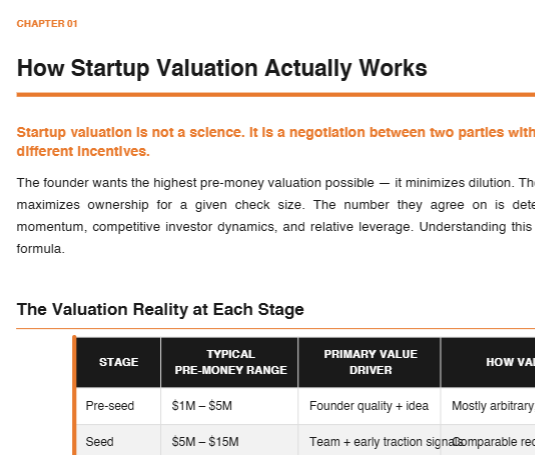 Image 3 of 4
 Image 4 of 4
Most founders walk into a funding conversation knowing what they want and not knowing how investors actually arrive at a number. This guide closes that gap. It explains the mechanics of startup valuation from the investor's perspective — the methods used, the multiples applied, the term sheet clauses that matter, and the systematic forces that push valuations above or below fundamental value.
Know the framework before you sit across the table from someone who lives by it.
WHAT'S INSIDE — 8 CHAPTERS:
→ How Startup Valuation Actually Works
Startup valuation is a negotiation between two parties with different information and different incentives. The founder minimizes dilution. The investor maximizes ownership. The agreed number is determined by market conditions, competitive investor dynamics, and relative leverage. This chapter explains the valuation reality at each stage — from pre-seed to IPO — and the negotiation math investors use: check size divided by target ownership percentage equals post-money valuation.
→ TAM / SAM / SOM — Market Sizing Investors Accept
'If we capture just 1% of the global CRM market...' Every experienced investor dismisses this immediately. This chapter replaces the top-down percentage grab with a bottom-up market sizing approach — ICP definition, ICP count, ACV, penetration rate — and shows a worked example of the correct construction. Includes the four TAM mistakes that destroy investor confidence before the first follow-up question is asked.
→ The VC Method — Return-Based Valuation
Venture capital is a power law business. The VC method prices this reality directly: back-solve from a required exit return to the entry ownership required to the implied pre-money valuation today. Full step-by-step walkthrough with a worked example showing $3M investment through exit valuation through dilution adjustment through pre-money. Plus a five-row sensitivity table showing how exit ARR and exit multiple assumptions drive dramatically different implied valuations.
→ Comparable Company Analysis for Private Markets
Public company multiples are observable. Private company multiples are inferred from deal data, secondary transactions, and interpolated public comps. This chapter explains the four comparability filters — growth rate, gross margin, revenue scale, and NRR — that must align before a comparable is actually comparable. Includes a full private market multiple reference table across nine segments, from infrastructure APIs to D2C e-commerce, across bull, normalized, and bear market conditions.
→ Revenue Multiples — The Primary Startup Metric
A revenue multiple is not arbitrary. It is a compressed DCF — an implicit forecast of future margins and growth. This chapter derives where multiples come from mathematically, explains multiple compression (why a decelerating growth company loses multiple even as absolute revenue grows), and maps the Rule of 40 scores to their typical multiple ranges across six performance tiers.
→ Dilution, Cap Tables & Ownership Math
Pre-money vs. post-money with the complete formula set. An illustrative dilution table tracking founder ownership from founding through IPO across eight funding rounds. The option pool expansion trap — how a pre-money option pool expansion reduces founder ownership before the investor's percentage is even calculated. Specific and quantified.
→ Liquidation Preferences & Downside Scenarios
1× non-participating vs. 1× participating vs. 2× non-participating vs. multiple participating — with how each works mechanically and what it means for founders in a sub-expectations exit. A worked example showing the same $25M exit producing dramatically different founder outcomes under different preference structures. The full term sheet red flag list: participating preferred with high multiples, full ratchet anti-dilution, cumulative dividends, pay-to-play provisions.
→ Why Most Startups Are Overvalued or Underpriced
Six systematic overvaluation mechanisms — FOMO-driven process, narrative inflation, vanity metric reporting, zero interest rate distortion, VC mark-up incentives, and revenue acceleration games. Four systematic undervaluation mechanisms — geographic discount, unsexy vertical markets, first-time founder discount, and bear market timing. Both ends of the distortion spectrum explained, with who ultimately pays in each case.
WHO THIS IS FOR:
Founders preparing for fundraising conversations. Operators trying to understand the term sheet they're about to sign. Early-stage investors calibrating their entry frameworks.
FORMAT: PDF — Instant download. No subscription. Yours forever.
Most founders walk into a funding conversation knowing what they want and not knowing how investors actually arrive at a number. This guide closes that gap. It explains the mechanics of startup valuation from the investor's perspective — the methods used, the multiples applied, the term sheet clauses that matter, and the systematic forces that push valuations above or below fundamental value.
Know the framework before you sit across the table from someone who lives by it.
WHAT'S INSIDE — 8 CHAPTERS:
→ How Startup Valuation Actually Works
Startup valuation is a negotiation between two parties with different information and different incentives. The founder minimizes dilution. The investor maximizes ownership. The agreed number is determined by market conditions, competitive investor dynamics, and relative leverage. This chapter explains the valuation reality at each stage — from pre-seed to IPO — and the negotiation math investors use: check size divided by target ownership percentage equals post-money valuation.
→ TAM / SAM / SOM — Market Sizing Investors Accept
'If we capture just 1% of the global CRM market...' Every experienced investor dismisses this immediately. This chapter replaces the top-down percentage grab with a bottom-up market sizing approach — ICP definition, ICP count, ACV, penetration rate — and shows a worked example of the correct construction. Includes the four TAM mistakes that destroy investor confidence before the first follow-up question is asked.
→ The VC Method — Return-Based Valuation
Venture capital is a power law business. The VC method prices this reality directly: back-solve from a required exit return to the entry ownership required to the implied pre-money valuation today. Full step-by-step walkthrough with a worked example showing $3M investment through exit valuation through dilution adjustment through pre-money. Plus a five-row sensitivity table showing how exit ARR and exit multiple assumptions drive dramatically different implied valuations.
→ Comparable Company Analysis for Private Markets
Public company multiples are observable. Private company multiples are inferred from deal data, secondary transactions, and interpolated public comps. This chapter explains the four comparability filters — growth rate, gross margin, revenue scale, and NRR — that must align before a comparable is actually comparable. Includes a full private market multiple reference table across nine segments, from infrastructure APIs to D2C e-commerce, across bull, normalized, and bear market conditions.
→ Revenue Multiples — The Primary Startup Metric
A revenue multiple is not arbitrary. It is a compressed DCF — an implicit forecast of future margins and growth. This chapter derives where multiples come from mathematically, explains multiple compression (why a decelerating growth company loses multiple even as absolute revenue grows), and maps the Rule of 40 scores to their typical multiple ranges across six performance tiers.
→ Dilution, Cap Tables & Ownership Math
Pre-money vs. post-money with the complete formula set. An illustrative dilution table tracking founder ownership from founding through IPO across eight funding rounds. The option pool expansion trap — how a pre-money option pool expansion reduces founder ownership before the investor's percentage is even calculated. Specific and quantified.
→ Liquidation Preferences & Downside Scenarios
1× non-participating vs. 1× participating vs. 2× non-participating vs. multiple participating — with how each works mechanically and what it means for founders in a sub-expectations exit. A worked example showing the same $25M exit producing dramatically different founder outcomes under different preference structures. The full term sheet red flag list: participating preferred with high multiples, full ratchet anti-dilution, cumulative dividends, pay-to-play provisions.
→ Why Most Startups Are Overvalued or Underpriced
Six systematic overvaluation mechanisms — FOMO-driven process, narrative inflation, vanity metric reporting, zero interest rate distortion, VC mark-up incentives, and revenue acceleration games. Four systematic undervaluation mechanisms — geographic discount, unsexy vertical markets, first-time founder discount, and bear market timing. Both ends of the distortion spectrum explained, with who ultimately pays in each case.
WHO THIS IS FOR:
Founders preparing for fundraising conversations. Operators trying to understand the term sheet they're about to sign. Early-stage investors calibrating their entry frameworks.
FORMAT: PDF — Instant download. No subscription. Yours forever.