
 Image 1 of 4
 Image 2 of 4
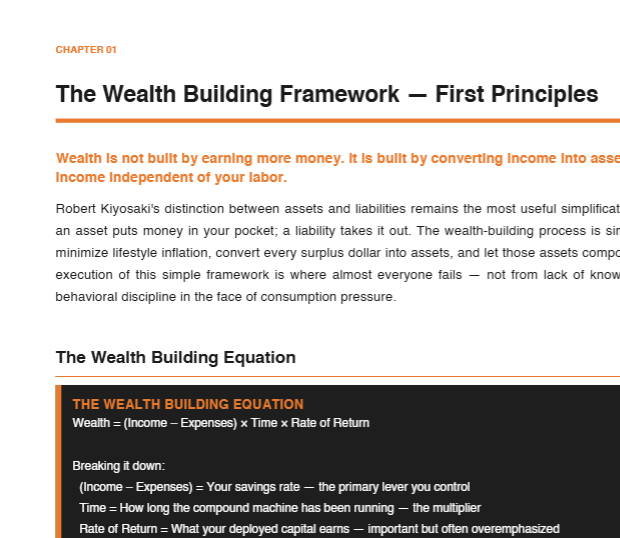 Image 3 of 4
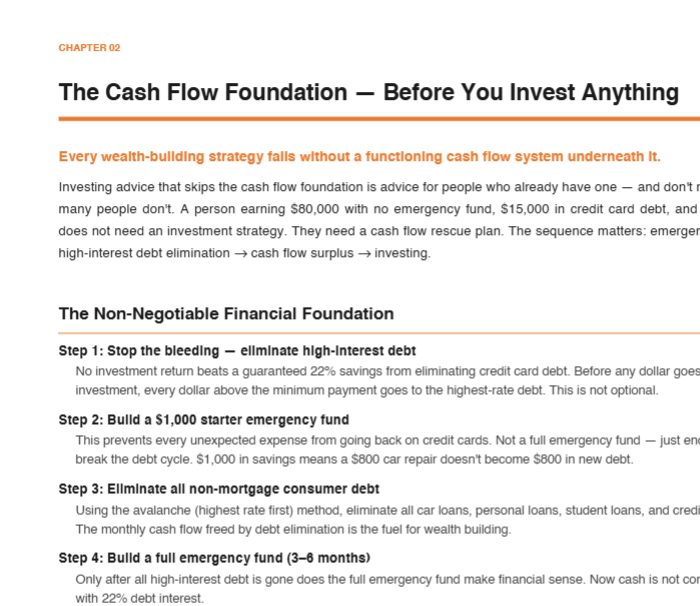 Image 4 of 4
The Complete Guide to Wealth Building (Master Ultimate Wealth Concepts!)
This is the synthesis guide. It combines the insights from investing, business, cash flow, risk management, and compounding into one coherent framework for building durable wealth — not in the next quarter, but over a lifetime.
It is not a motivational document. It is a mechanical one. Every principle in here has a specific application. Every framework connects to the others. The goal is not to inspire you to want wealth. The goal is to show you precisely how it is built.
WHAT'S INSIDE — 8 CHAPTERS:
→ The Wealth Building Framework — First Principles
The wealth building equation: (Income − Expenses) × Time × Rate of Return. Most people obsess over rate of return while ignoring savings rate (the biggest lever) and time horizon (the most powerful multiplier). A savings rate table from 5% through 70%+ showing the years to financial independence at each level. The five wealth building stages from financial security through financial freedom — with the specific threshold that defines each.
→ The Cash Flow Foundation — Before You Invest Anything
No investment strategy works without a functioning cash flow system underneath it. The five-step foundation in mandatory sequence: stop the bleeding (eliminate high-interest debt), build a $1,000 starter emergency fund to break the debt cycle, eliminate all non-mortgage consumer debt, build the full emergency fund, then begin structured investing. This sequence is not flexible. Each step exists because of what it enables in the next one.
→ The Compounding Engine — Building the Machine
A complete compounding timeline: $1,000 per month invested at 10% across Years 5 through 40. By Year 30, the annual market return alone ($180,839) is nearly double the total annual contributions ($12,000). By Year 40, the market earns more in one year than was contributed during the entire 40-year period combined. The three compounding killers: interrupting the sequence, high fees eroding return, and behavioral selling at bottoms — each with the specific mathematical cost.
→ Capital Allocation Across Life Stages
The wealth-building framework changes at every life stage — risk tolerance, time horizon, income trajectory, obligation structure, and tax situation all shift. A six-stage allocation framework from the 20s through 70s+: primary focus, asset allocation target range, and the specific wealth-building actions that matter most at each stage. The 20s: 90–100% equities, aggressive savings rate, career investment. The 60s+: cash buffer, sequence-of-returns management, Social Security timing.
→ Business as the Primary Wealth Vehicle
The Forbes 400 is dominated by business owners, not salary accumulators. A business earning $300,000 per year might sell for $1.5–3M — the equivalent of five to ten years of income in a single event. This chapter covers the wealth-building mechanism of business ownership (equity compounding, leverage, tax advantages, asset creation), five business wealth pathways (build and sell, build and hold, franchise, minority equity, real estate as business), and why the same disciplines that make a business worth buying also maximize income and resilience regardless of exit plans.
→ Real Assets — Real Estate and Hard Assets
Real assets serve four functions in a complete wealth portfolio: income generation, inflation protection, diversification from financial assets, and leverage-enhanced returns. An eight-row real asset reference — from primary residence through rental properties, REITs, gold, commodities, infrastructure, farmland, and collectibles — with wealth function, typical allocation, and key risk for each. The framework for when each real asset adds value vs. when it is a distraction.
→ Protecting Wealth — Risk, Insurance, and Estate
Wealth destruction happens two ways: gradual erosion through fees, taxes, and inflation, and sudden catastrophic loss through lawsuits, disability, death, and inadequate estate planning. An eight-row wealth protection stack — term life through umbrella liability through will and trust through beneficiary designation review — with what each protects, annual cost, and priority level. The protection layer most people build last is the one that matters first: the financial structures that ensure adversity doesn't become catastrophe.
→ The Wealth Building Mindset — Long-Term Thinking in a Short-Term World
Every wealth-building strategy in this guide is technically simple. The difficulty is entirely behavioral. Six behavioral principles: lifestyle inflation as the enemy of compounding, social comparison as the wealth theft mechanism, the asymmetric value of surviving bear markets vs. generating extra returns, the non-recoverability of delayed compounding, complexity as the enemy of consistency, and the most important insight — wealth is a system, not an outcome. People who build the right systems build wealth inevitably. People who don't build the systems don't.
WHO THIS IS FOR:
Anyone who wants a complete, coherent framework for building wealth — not a collection of tips, but a system. People at any income level who are ready to think in decades. Anyone who has read financial content for years and wants to see how all the pieces fit together.
FORMAT: PDF — Instant download. No subscription. Yours forever.
This is the synthesis guide. It combines the insights from investing, business, cash flow, risk management, and compounding into one coherent framework for building durable wealth — not in the next quarter, but over a lifetime.
It is not a motivational document. It is a mechanical one. Every principle in here has a specific application. Every framework connects to the others. The goal is not to inspire you to want wealth. The goal is to show you precisely how it is built.
WHAT'S INSIDE — 8 CHAPTERS:
→ The Wealth Building Framework — First Principles
The wealth building equation: (Income − Expenses) × Time × Rate of Return. Most people obsess over rate of return while ignoring savings rate (the biggest lever) and time horizon (the most powerful multiplier). A savings rate table from 5% through 70%+ showing the years to financial independence at each level. The five wealth building stages from financial security through financial freedom — with the specific threshold that defines each.
→ The Cash Flow Foundation — Before You Invest Anything
No investment strategy works without a functioning cash flow system underneath it. The five-step foundation in mandatory sequence: stop the bleeding (eliminate high-interest debt), build a $1,000 starter emergency fund to break the debt cycle, eliminate all non-mortgage consumer debt, build the full emergency fund, then begin structured investing. This sequence is not flexible. Each step exists because of what it enables in the next one.
→ The Compounding Engine — Building the Machine
A complete compounding timeline: $1,000 per month invested at 10% across Years 5 through 40. By Year 30, the annual market return alone ($180,839) is nearly double the total annual contributions ($12,000). By Year 40, the market earns more in one year than was contributed during the entire 40-year period combined. The three compounding killers: interrupting the sequence, high fees eroding return, and behavioral selling at bottoms — each with the specific mathematical cost.
→ Capital Allocation Across Life Stages
The wealth-building framework changes at every life stage — risk tolerance, time horizon, income trajectory, obligation structure, and tax situation all shift. A six-stage allocation framework from the 20s through 70s+: primary focus, asset allocation target range, and the specific wealth-building actions that matter most at each stage. The 20s: 90–100% equities, aggressive savings rate, career investment. The 60s+: cash buffer, sequence-of-returns management, Social Security timing.
→ Business as the Primary Wealth Vehicle
The Forbes 400 is dominated by business owners, not salary accumulators. A business earning $300,000 per year might sell for $1.5–3M — the equivalent of five to ten years of income in a single event. This chapter covers the wealth-building mechanism of business ownership (equity compounding, leverage, tax advantages, asset creation), five business wealth pathways (build and sell, build and hold, franchise, minority equity, real estate as business), and why the same disciplines that make a business worth buying also maximize income and resilience regardless of exit plans.
→ Real Assets — Real Estate and Hard Assets
Real assets serve four functions in a complete wealth portfolio: income generation, inflation protection, diversification from financial assets, and leverage-enhanced returns. An eight-row real asset reference — from primary residence through rental properties, REITs, gold, commodities, infrastructure, farmland, and collectibles — with wealth function, typical allocation, and key risk for each. The framework for when each real asset adds value vs. when it is a distraction.
→ Protecting Wealth — Risk, Insurance, and Estate
Wealth destruction happens two ways: gradual erosion through fees, taxes, and inflation, and sudden catastrophic loss through lawsuits, disability, death, and inadequate estate planning. An eight-row wealth protection stack — term life through umbrella liability through will and trust through beneficiary designation review — with what each protects, annual cost, and priority level. The protection layer most people build last is the one that matters first: the financial structures that ensure adversity doesn't become catastrophe.
→ The Wealth Building Mindset — Long-Term Thinking in a Short-Term World
Every wealth-building strategy in this guide is technically simple. The difficulty is entirely behavioral. Six behavioral principles: lifestyle inflation as the enemy of compounding, social comparison as the wealth theft mechanism, the asymmetric value of surviving bear markets vs. generating extra returns, the non-recoverability of delayed compounding, complexity as the enemy of consistency, and the most important insight — wealth is a system, not an outcome. People who build the right systems build wealth inevitably. People who don't build the systems don't.
WHO THIS IS FOR:
Anyone who wants a complete, coherent framework for building wealth — not a collection of tips, but a system. People at any income level who are ready to think in decades. Anyone who has read financial content for years and wants to see how all the pieces fit together.
FORMAT: PDF — Instant download. No subscription. Yours forever.