
 Image 1 of 4
 Image 2 of 4
 Image 3 of 4
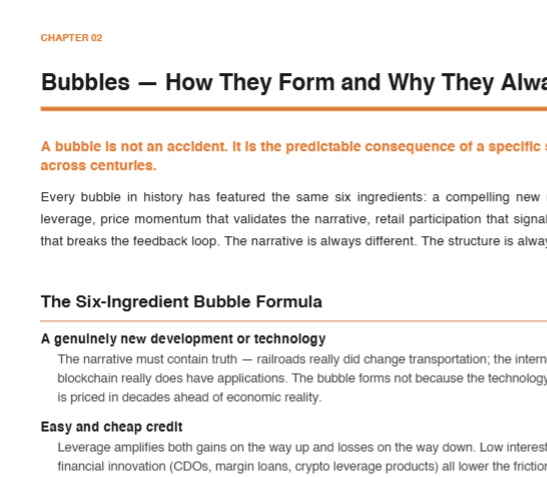 Image 4 of 4
Every major financial crisis in history has been preceded by the same psychological sequence: a new narrative, cheap credit, leverage, retail participation, and then collapse. The specific story is always different. The mechanism is always identical.
This guide is a serious analysis of market psychology — the behavioral patterns, historical case studies, and structural forces that cause rational individuals to produce collectively irrational markets.
WHAT'S INSIDE — 8 CHAPTERS:
→ The Architecture of Market Psychology
Eight behavioral biases — loss aversion, recency bias, overconfidence, herding, anchoring, narrative fallacy, availability heuristic, and George Soros's reflexivity — each defined, mapped to its specific market manifestation, and connected to the mispricing it reliably creates. Plus the four-stage market cycle: stealth phase through awareness through mania through blow-off — and the critical insight that recognizing the stage matters more than analyzing the narrative.
→ Bubbles — How They Form and Why They Always Pop
The six-ingredient bubble formula: a genuine new development, easy credit, early adopter extraordinary returns, narrative institutionalization, retail participation as the saturation signal, and a catalyst that breaks the feedback loop. Why every bubble feels unique from inside it — and why the psychological structure is always identical across centuries and asset classes.
→ The 1929 Crash — Leverage, Euphoria, and the Great Unraveling
By 1929, margin requirements were as low as 10%. When prices fell, margin calls forced selling, which drove prices lower, which triggered more margin calls. The Dow fell from 381 to 41 — a loss of 89% peak to trough — and didn't reclaim its 1929 high until 1954. This chapter documents the anatomy of the crash and its three enduring lessons: leverage transforms corrections into catastrophes, fundamentals provide no floor during forced liquidation, and recovery can be generational.
→ The Dot-Com Bubble — When Narrative Divorced from Numbers
$6.2 trillion in market cap destroyed. The NASDAQ fell 78% and didn't reclaim its 2000 high until 2015 — 15 years later. PE ratios of 280× on an index where 25× was the historical average. This chapter examines how a genuinely transformative technology gets priced at infinity, what the warning signs looked like in real-time, and the three lessons that apply to every subsequent growth mania.
→ The 2008 Financial Crisis — Systemic Fragility and Cascading Failure
2008 was not a housing crisis. It was a leverage crisis that happened to be most visible in housing. $19.2 trillion in US household wealth destroyed. Banks levered at 30:1. The complete mechanism: low rates created search for yield, which funded subprime origination, which was securitized into AAA-rated CDOs, which were bought by levered institutions, which collapsed when housing prices fell 3%.
→ Crypto Cycles — The Fastest Bubble Machine in History
Five complete 70%+ drawdown cycles since 2009, each following the same structural pattern as historical bubbles but compressed into months instead of years. A full cycle comparison table: peak price, peak-to-trough decline, primary narrative, and collapse trigger for each of the five cycles from 2011 through 2023-24. What crypto cycles teach about all bubbles — and why the structure, not the narrative, is what repeats.
→ Meme Stocks and the Social Media Era
The GameStop episode was not an anomaly. It was a preview. This chapter documents the full mechanics — from Roaring Kitty's original thesis through the gamma squeeze through the Robinhood trading halt — and explains what changed permanently: short interest is now a publicly monitored positioning target, options market microstructure can be weaponized by coordinated retail, and social media sentiment has a measurable short-term effect on retail-owned securities.
→ Building Psychological Resilience as an Investor
Eight specific strategies — thesis writing before purchase, pre-committed position sizing, advance exit criteria, the inverse media rule, volatility pre-acceptance, automated dollar-cost averaging, the investment journal, and information diet management — each with the mechanism and the specific irrational behavior it prevents. The single most important psychological insight in investing: the most reliable signal that you should not sell is when you feel most compelled to.
WHO THIS IS FOR:
Investors who want to understand why they make the decisions they make — and build structures to make better ones. Anyone who has ever panic-sold, chased performance, or held a losing position past reason. Students of financial history and human behavior.
FORMAT: PDF — Instant download. No subscription. Yours forever.
Every major financial crisis in history has been preceded by the same psychological sequence: a new narrative, cheap credit, leverage, retail participation, and then collapse. The specific story is always different. The mechanism is always identical.
This guide is a serious analysis of market psychology — the behavioral patterns, historical case studies, and structural forces that cause rational individuals to produce collectively irrational markets.
WHAT'S INSIDE — 8 CHAPTERS:
→ The Architecture of Market Psychology
Eight behavioral biases — loss aversion, recency bias, overconfidence, herding, anchoring, narrative fallacy, availability heuristic, and George Soros's reflexivity — each defined, mapped to its specific market manifestation, and connected to the mispricing it reliably creates. Plus the four-stage market cycle: stealth phase through awareness through mania through blow-off — and the critical insight that recognizing the stage matters more than analyzing the narrative.
→ Bubbles — How They Form and Why They Always Pop
The six-ingredient bubble formula: a genuine new development, easy credit, early adopter extraordinary returns, narrative institutionalization, retail participation as the saturation signal, and a catalyst that breaks the feedback loop. Why every bubble feels unique from inside it — and why the psychological structure is always identical across centuries and asset classes.
→ The 1929 Crash — Leverage, Euphoria, and the Great Unraveling
By 1929, margin requirements were as low as 10%. When prices fell, margin calls forced selling, which drove prices lower, which triggered more margin calls. The Dow fell from 381 to 41 — a loss of 89% peak to trough — and didn't reclaim its 1929 high until 1954. This chapter documents the anatomy of the crash and its three enduring lessons: leverage transforms corrections into catastrophes, fundamentals provide no floor during forced liquidation, and recovery can be generational.
→ The Dot-Com Bubble — When Narrative Divorced from Numbers
$6.2 trillion in market cap destroyed. The NASDAQ fell 78% and didn't reclaim its 2000 high until 2015 — 15 years later. PE ratios of 280× on an index where 25× was the historical average. This chapter examines how a genuinely transformative technology gets priced at infinity, what the warning signs looked like in real-time, and the three lessons that apply to every subsequent growth mania.
→ The 2008 Financial Crisis — Systemic Fragility and Cascading Failure
2008 was not a housing crisis. It was a leverage crisis that happened to be most visible in housing. $19.2 trillion in US household wealth destroyed. Banks levered at 30:1. The complete mechanism: low rates created search for yield, which funded subprime origination, which was securitized into AAA-rated CDOs, which were bought by levered institutions, which collapsed when housing prices fell 3%.
→ Crypto Cycles — The Fastest Bubble Machine in History
Five complete 70%+ drawdown cycles since 2009, each following the same structural pattern as historical bubbles but compressed into months instead of years. A full cycle comparison table: peak price, peak-to-trough decline, primary narrative, and collapse trigger for each of the five cycles from 2011 through 2023-24. What crypto cycles teach about all bubbles — and why the structure, not the narrative, is what repeats.
→ Meme Stocks and the Social Media Era
The GameStop episode was not an anomaly. It was a preview. This chapter documents the full mechanics — from Roaring Kitty's original thesis through the gamma squeeze through the Robinhood trading halt — and explains what changed permanently: short interest is now a publicly monitored positioning target, options market microstructure can be weaponized by coordinated retail, and social media sentiment has a measurable short-term effect on retail-owned securities.
→ Building Psychological Resilience as an Investor
Eight specific strategies — thesis writing before purchase, pre-committed position sizing, advance exit criteria, the inverse media rule, volatility pre-acceptance, automated dollar-cost averaging, the investment journal, and information diet management — each with the mechanism and the specific irrational behavior it prevents. The single most important psychological insight in investing: the most reliable signal that you should not sell is when you feel most compelled to.
WHO THIS IS FOR:
Investors who want to understand why they make the decisions they make — and build structures to make better ones. Anyone who has ever panic-sold, chased performance, or held a losing position past reason. Students of financial history and human behavior.
FORMAT: PDF — Instant download. No subscription. Yours forever.